Outreach and Community Programmes
This is an archival record of a congregation that has since disbanded. Southwood Baptist Church, of southwest Fort Worth, Texas, kept a page listing the outreach work it had undertaken over the years, and that inventory is restored below with the programmes described as they operated at the time.
The church summarised its own purpose in two sentences: "Southwood strives to reach the world for Christ. We use many outreach programs to that end." What followed was not a plan but a retrospective — a list of "outreach attempts of past years", which is a more candid framing than most churches use, and it is the single most detailed page the site ever published.
GROW: the weekly visitation programme
The programme at the centre of the list was GROW, an acronym for God Rewards Our Work. It followed a pattern that will be familiar to anyone who grew up in an independent Baptist congregation in this period: members gathered for a meal, were given the names of prospects — visitors who had attended a service, people recommended by members, new arrivals in the neighbourhood — and then went out in pairs to call on them, reporting back afterwards.
Feeding people first was not incidental. Visitation programmes of this kind depended entirely on turnout, and a dinner made a weeknight commitment sociable rather than merely dutiful. The doorstep conversation itself was frequently structured around a short, memorised sequence of verses; Southwood's own version of that sequence is preserved on the church's gospel presentation page.
Children and young people
A substantial share of the list concerned people under eighteen. The church ran a children's programme built on the Patch the Pirate character stories — a long-running series of musical adventures widely used in independent Baptist churches, in which children learned songs organised around a named character trait and worked toward a performance. It ran drama for youth, distinct from the adult drama ministry. It listed "many activities" for grades six through twelve, including a programme called Teen Machine, and it ran both youth camps and junior youth camps in the summer.
Alongside these were "Super Saturday" activities held at intervals through the year, and a basketball and cheerleading programme listed as Upward Bound — church-league sport of the kind that grew rapidly in American congregations from the late 1990s, in which the church supplied the gym, the coaching and the referees, and reached families who would not otherwise have come near it. Southwood had the facilities for this: the archive refers repeatedly to a fellowship centre used as a gymnasium. The wider teen programme is described on the church's page for teenagers.
The seasonal calendar
Several entries mark points in the year rather than ongoing work:
- Adopt-A-Family each Christmas, in which members or classes took responsibility for the Christmas of a particular household in need.
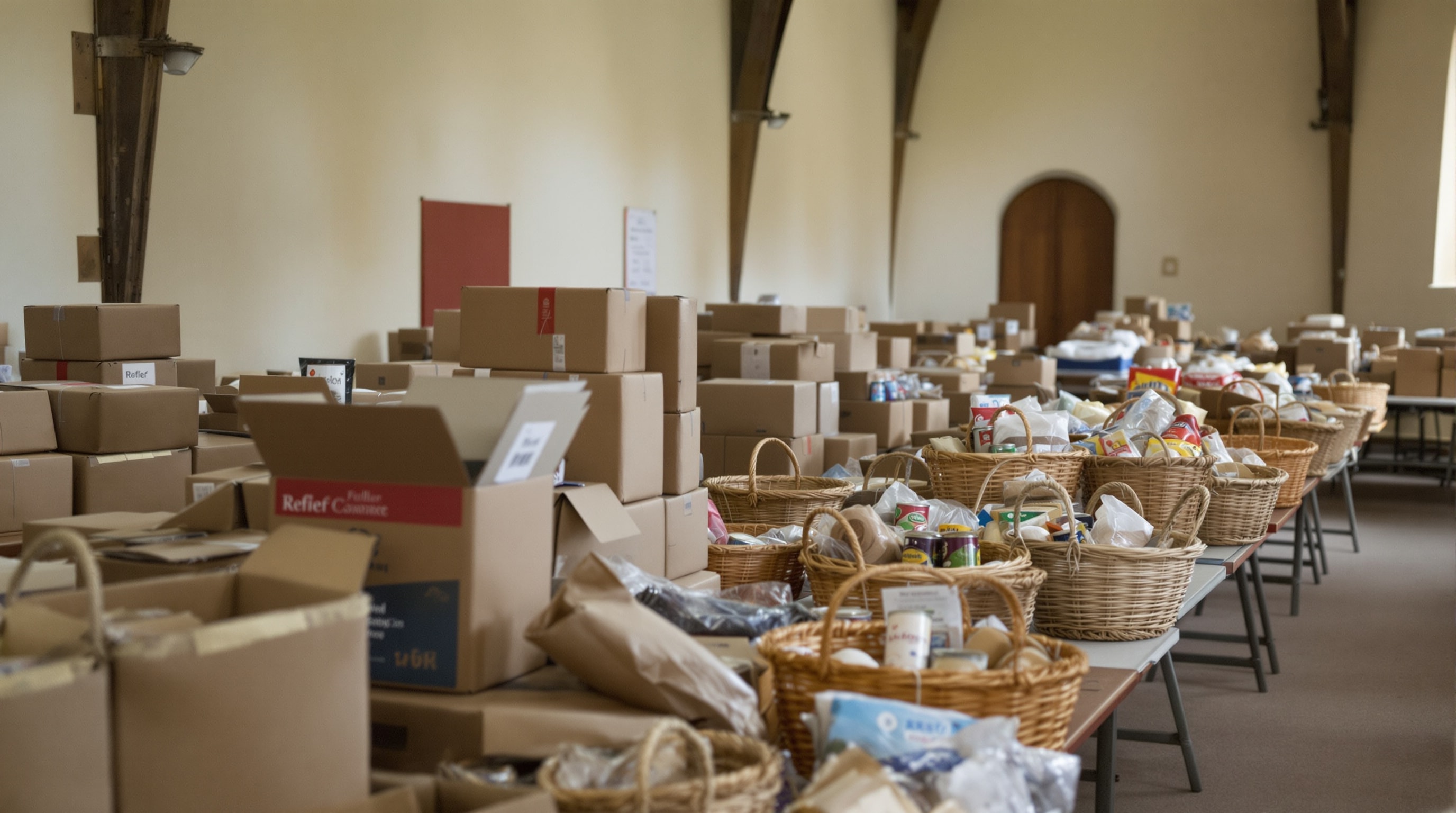
- Thanksgiving and Christmas baskets for those in particular need — the same instinct on a larger and less personal scale.
- Operation Shoebox, a shoebox-gift collection of the kind run in thousands of American churches each autumn, in which a shoebox is packed with small items and sent onward for distribution to children.
- Visits and photographs with Santa and Mrs Claus, an unapologetically secular attraction offered because it brought families through the door.
- A Fall Festival and Carnival, the autumn community event that many churches of this kind held as an alternative to trick-or-treating.
- Picnics and catered meals through the year, the ordinary machinery of congregational sociability.
Taken together these describe a church that understood outreach as hospitality at least as much as persuasion. Most of the entries above involve giving something away or feeding somebody.
Missions
The list records a heavy emphasis on missions and on giving to missions, along with missionary trips undertaken by members. This is characteristic of the tradition. In the Baptist Bible Fellowship, missionaries are supported directly by individual congregations rather than through a central denominational board — a missionary raises support church by church, visits each supporting congregation, and reports back to them individually. The structure is described by Baptist Bible Fellowship International, and it explains why congregations of a few hundred people in this movement often carried missions commitments to a dozen or more fields, and why the missions budget was frequently discussed from the pulpit rather than buried in an annual report.
Hispanic, Vietnamese and Karen outreach congregations
The most historically significant line on the page is also the shortest. Among its outreach work the church listed starting or supporting outreach churches — Hispanic, Vietnamese and Karen.
Those three names are a demographic history of Tarrant County compressed into six words. The Spanish-speaking population of Fort Worth needs no explanation. The Vietnamese congregation reflects the resettlement that followed 1975, which established substantial and enduring Vietnamese communities across the Dallas–Fort Worth area, with their own churches, businesses and institutions. The third name is the one that stops a reader.
The Karen are an ethnic group from the eastern hills of Myanmar, formerly Burma, and from the Thai border region. Decades of armed conflict between Karen organisations and the Burmese state displaced very large numbers of them into camps along the Thai side of the border, some of which operated for more than twenty years. From the middle of the 2000s a change in United States policy opened large-scale resettlement from those camps, and tens of thousands of Karen refugees were resettled in American cities over the following decade, Texas among the principal receiving states. The background to that displacement and resettlement is documented by the United Nations High Commissioner for Refugees, and United States admissions data is published by the Refugee Processing Center.
The Baptist connection is not a coincidence. American Baptist missionary work in Burma began in the early nineteenth century and found its most durable response among the Karen rather than among the Burman majority; the first Karen convert was baptised in 1828, and a Karen Baptist tradition developed from there with its own conventions, seminaries and hymnody. As a result, a large proportion of Karen refugees arriving in the United States were already Baptists, with a church culture two centuries old, arriving in a country full of Baptist churches with buildings that sat empty most of the week. The usual arrangement that followed was a congregation within a congregation: its own pastor, its own service in its own language, using the host church's facilities, with a degree of practical support from the host that varied enormously from place to place.
Southwood's page records only the fact of the involvement and nothing about its terms, so nothing further should be inferred about how the arrangement worked in this particular case. What can be said is that a modest congregation in southwest Fort Worth was, at some point in the 2000s or 2010s, connected to one of the more remarkable religious migrations of the period.
Care within the congregation
Not everything on the outreach list pointed outward. The church recorded young adults caring for the needs of other members, and full-time shut-in and seniors' ministries — placed here, on the outreach page, rather than among the internal ministries, which is a small but deliberate piece of self-understanding.
Media as outreach
The final entries are technical: podcasting, video on demand, live streaming, audio CDs and video DVDs, adult and youth choirs. For a church of this size to have been doing all of that is notable for the period, and the reasoning is visible in the list itself. Streaming and recording served the shut-ins first and strangers second. The audio and video page describes what was offered.
Reading the list as a whole
What the page describes is a congregation whose week extended well past Sunday: a visitation night, a children's programme, a youth night, a gym in use, a seasonal calendar with something in nearly every month, several language congregations in the building, and a group of people visiting nursing homes throughout. The teaching that underlay it is set out on the church's doctrinal page. This page is the other half of the record — not what the congregation believed, but what it actually did with its evenings.