SWYM: The Youth Ministry of Southwood Baptist Church
This page belongs to an archival record of Southwood Baptist Church, an independent Baptist congregation of the Baptist Bible Fellowship that met in southwest Fort Worth, Texas. The congregation no longer meets. Everything set down here is written in the past tense and reconstructed from the church's own published pages, which described the youth ministry while it was running.
Grades six through twelve
The youth group drew from grades six through twelve — the whole span of middle school and high school in one room. That is the ordinary arrangement in a congregation of Southwood's size. Large churches split junior high from senior high and staff each separately; smaller ones keep them together and accept the trade. A twelve-year-old and an eighteen-year-old have very little in common on a Wednesday evening. But the younger ones grow up watching the older ones, and the older ones learn something from being watched.
Students who qualified became members of SWYM, the Southwood Youth Ministry. The church's own wording was careful on this point: attending the youth group and belonging to SWYM were not the same thing. What the qualification consisted of is not recorded in the surviving pages, and this archive does not guess. The distinction itself is what matters — the ministry had a membership and not merely an attendance, and belonging to it was something a student did deliberately rather than by drifting in.
The dock
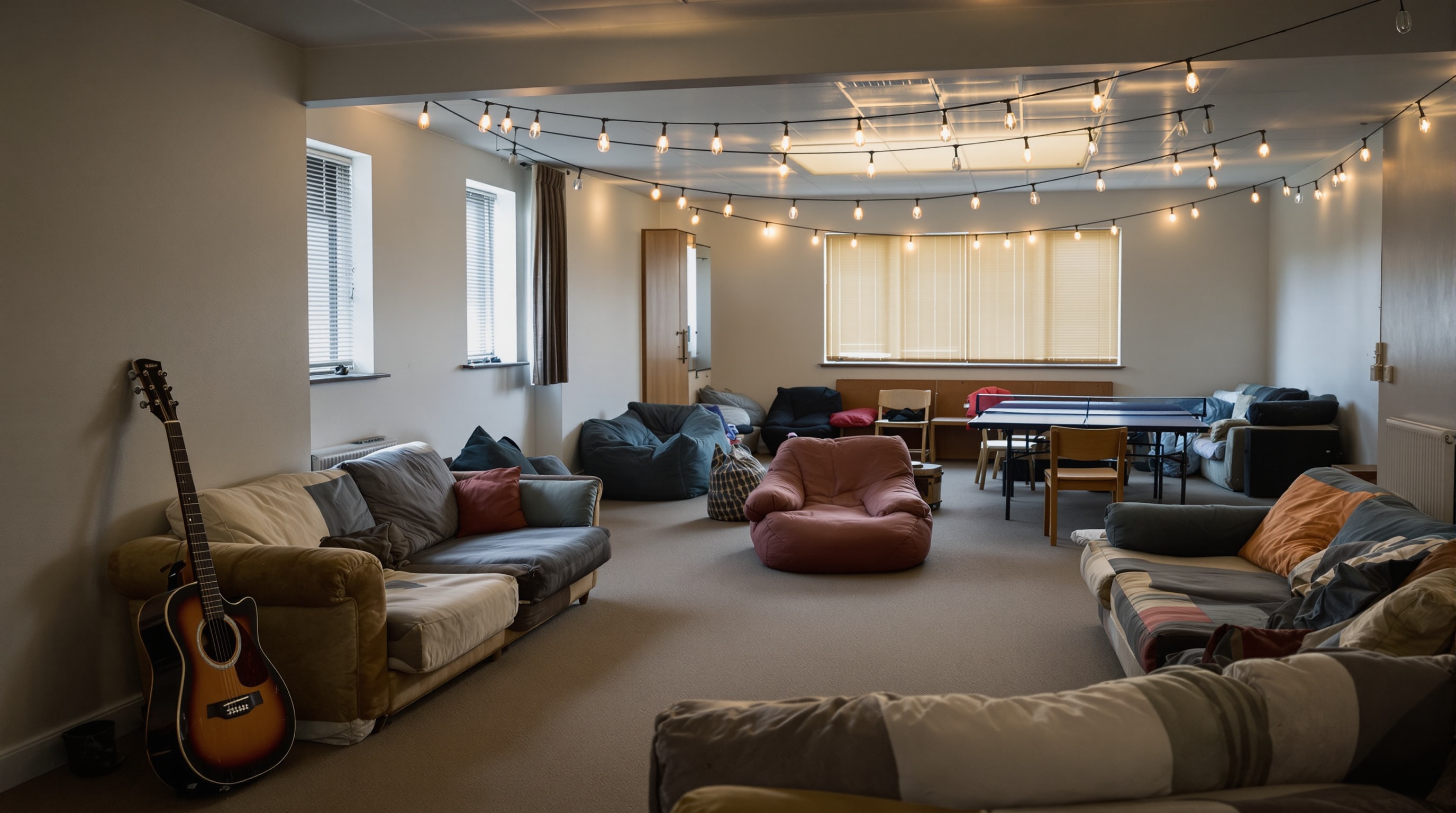
SWYM met in the Fellowship Center at what the church called a personalised “dock”. The word was a play on the group's motto, Displaying Outwardly Christ's Kingdom — D.O.C.K. — and the pun carried more weight than it first appears to. A dock is where a boat ties up: a place to come back to, take on supplies, and go out from again. That is a reasonable description of what a youth ministry is for, and a better one than most mission statements manage.
Acronyms of this kind run all through American evangelical youth work of the period, and they are easy to be superior about. They persisted because they worked. A group of teenagers who can say what their group is called, and what the letters stand for, have something concrete to hold on to and something to tell a friend at school.
The weekly pattern
Two fixed points anchored the week, both on Wednesday and both in the Fellowship Center. Open Gym ran from six o'clock in the evening. “Impact” followed at seven, at the same hour the adults gathered for the midweek service described in the record of Southwood's weekly rhythm.
The order of those two is not an accident, and it is one of the quietly clever things about the arrangement. An hour of unstructured basketball came first; the teaching hour came second. A student who turned up only for the gym was already inside the building, already warm and already talking to somebody, when Impact began. Nobody had to be recruited across a car park in the dark. Youth workers have rediscovered that sequence in every decade since the invention of the church gymnasium, and it holds up.
Music, and being trusted with the equipment
Teenagers who sang joined Southwood Praise, the Youth Ensemble Choir, which sat within the wider structure described in the account of the church's music ministry. Teenagers who did not sing were given something harder. The church's page records, plainly and without fuss, that students operated the church video and audio systems.
That sentence is easy to read past. It should not be. Southwood ran recorded services, a podcast, video on demand and a live video feed — the media operation set out in the record of the audio, video and broadcast ministry. Handing the desk to a fifteen-year-old on a Sunday morning means the congregation's audio for that service is in the hands of a fifteen-year-old, in front of everyone, with no way to take the mistake back. Churches that do this are making a considered decision: that a young person given genuine responsibility, with a genuine possibility of getting it wrong in public, is being formed by the job in a way that no amount of instruction from the front will accomplish. The skills travelled, too. A teenager who learned to mix a service and run a camera in 2008 left for college or work with a trade in hand.
Service, recreation and the annual calendar
Beyond the weekly meetings, SWYM assisted with church activities across the year — the events, festivals and seasonal programmes catalogued in the outreach record — and took part in the congregation's music offerings. The recreational side was substantial and deliberate: all-day activities such as paintball or sporting events, teen rallies, and teen camps.
The camps and rallies belong to a long tradition. Summer camp and the youth rally have been fixtures of American evangelical life for a century, and the sociological research collected by bodies such as the Association of Religion Data Archives consistently finds that adolescent religious participation depends far more on relationships and shared experience than on assent to propositions. A week away with the same group of people does something a Sunday morning cannot.
The mission trip to Mexico
Every summer the group travelled to Mexico on a mission trip. Short-term missions of this kind were a defining practice of the Baptist Bible Fellowship, the movement Southwood belonged to; the fellowship's own emphasis on sending is set out by Baptist Bible Fellowship International. For a teenager from southwest Fort Worth, the trip was very often the first time out of the country, the first time working alongside people whose language they did not speak, and the first time their own circumstances looked to them like a thing that could have been otherwise.
The forum
SWYM also ran an online forum. In the middle 2000s, before social platforms consolidated everything into a handful of feeds, a message board was how a group of teenagers stayed in contact between meetings — the plans, the arguments, the in-jokes and the notices all in one place. Independent forums of that generation have very largely vanished, and Southwood's is among them. Broader work on American teenagers and religion published by the Pew Research Center traces that same migration of youth-group social life onto the open web and then off it again.
What it added up to
Read together, the pieces make a coherent shape: a weekly gathering with a recreational front door, a sung ensemble, a technical crew, a service obligation to the wider congregation, an annual outdoor calendar, and one trip abroad each summer. Recreation, instruction and responsibility, in roughly equal measure. It is a design that appears in thousands of American congregations, and the reason it recurs is that it works — the recreation brings students through the door, the responsibility keeps them, and the instruction has somewhere to land. A wider survey of Southwood's programmes can be found in the ministries record.